Author

admin

Browsing

/NOT FOR DISSEMINATION IN THE UNITED STATES OR THROUGH U.S. NEWSWIRE SERVICES/

finlay minerals ltd. (TSXV: FYL,OTC:FYMNF) (OTCQB: FYMNF) (‘Finlay’ or the ‘Company’) is pleased to announce that it has closed its non-brokered private placement (the ‘Private Placement’), previously announced on October 6, 2025, consisting of the issuance of: (i) 10,633,999 flow-through units of the Company (each, a ‘FT Unit’) at a price of $0.15 per FT Unit, and (ii) 883,000 non-flow-through units of the Company (each, a ‘NFT Unit’) at a price of $0.13 per NFT Unit, for aggregate gross proceeds to the Company of $1,709,890.

Each FT Unit is comprised of one common share of the Company issued on a flow-through basis under the Income Tax Act (Canada) (a ‘FT Share‘) and one-half of one non-flow-through common share purchase warrant (each whole warrant, a ‘Warrant‘). Each Warrant is exercisable by the holder thereof to acquire one non-flow-through common share of the Company (a ‘NFT Share‘) at an exercise price of $0.25 per NFT Share until October 17, 2027.

Each NFT Unit is comprised of one NFT Share and one Warrant with identical terms to the Warrants underlying the FT Units.

The Company intends to use the gross proceeds of the Private Placement for exploration of the Company’s SAY, JJB and Silver Hope properties, and for general working capital purposes, as more particularly described in the offering document for the Private Placement. The Company will use the gross proceeds from the issuance of FT Shares to incur ‘Canadian exploration expenses’ and qualify as ‘flow-through critical mineral mining expenditures’, as such terms are defined in the Income Tax Act (Canada).

The Private Placement was conducted pursuant to the listed issuer financing exemption under Part 5A of National Instrument 45-106 – Prospectus Exemptions and in reliance on the Coordinated Blanket Order 45-935 – Exemptions from Certain Conditions of the Listed Issuer Financing Exemption. The securities issued to purchasers in the Private Placement are not subject to a hold period under applicable Canadian securities laws. The Private Placement is subject to final approval of the TSX Venture Exchange.

The Company paid aggregate cash finder’s fees of $96,550.78 and issued 648,358 non-transferable finder warrants (each a ‘Finder Warrant‘) to arm’s length finders of the Company, as compensation for identifying purchasers in the Private Placement. Each Finder Warrant entitles the holder thereof to purchase one NFT Share at an exercise price of $0.25 per NFT Share until October 17, 2027. The Finder Warrants and the NFT Shares issued on exercise thereof are subject to a hold period expiring on February 18, 2026 in accordance with applicable securities laws.

This press release shall not constitute an offer to sell or the solicitation of an offer to buy nor shall there be any sale of the securities in the United States or in any other jurisdiction in which such offer, solicitation or sale would be unlawful. The securities have not been registered under the United States Securities Act of 1933, as amended, and may not be offered or sold in the United States absent registration or an applicable exemption from the registration requirements thereunder.

About finlay minerals ltd.

Finlay is a TSXV company focused on exploration for base and precious metal deposits through the advancement of its ATTY, PIL, JJB, SAY and Silver Hope Properties; these properties host copper-gold porphyry and gold-silver epithermal targets within different porphyry districts of northern and central BC. All of the properties are located in areas of recent copper-gold porphyry discoveries.

Finlay trades under the symbol ‘FYL’ on the TSXV and under the symbol ‘FYMNF’ on the OTCQB. For further information and details, please visit the Company’s website at www.finlayminerals.com 

On behalf of the Board of Directors,

Robert F. Brown,
Executive Chairman of the Board

Neither the TSXV nor its Regulation Services Provider (as that term is defined in the policies of the TSXV) accepts responsibility for the adequacy or accuracy of this release.

Forward-Looking Information: This news release includes certain ‘forward-looking information’ and ‘forward-looking statements’ (collectively, ‘forward-looking statements’) within the meaning of applicable Canadian securities legislation. All statements in this news release that address events or developments that we expect to occur in the future are forward-looking statements. Forward-looking statements are statements that are not historical facts and are generally, although not always, identified by words such as ‘expect’, ‘plan’, ‘anticipate’, ‘project’, ‘target’, ‘potential’, ‘schedule’, ‘forecast’, ‘budget’, ‘estimate’, ‘intend’ or ‘believe’ and similar expressions or their negative connotations, or that events or conditions ‘will’, ‘would’, ‘may’, ‘could’, ‘should’ or ‘might’ occur. All such forward-looking statements are based on the opinions and estimates of management as of the date such statements are made. Forward-looking statements in this news release include statements regarding, among others, the final approval for the Private Placement from the TSXV and the planned use of proceeds for the Private Placement. Although Finlay believes the expectations expressed in such forward-looking statements are based on reasonable assumptions, such statements are not guarantees of future performance and actual results or developments may differ materially from those forward-looking statements. Factors that could cause actual results to differ materially from those in forward-looking statements include the ability to obtain regulatory approval for the Private Placement, the state of equity markets in Canada and other jurisdictions, market prices, exploration successes, and continued availability of capital and financing and general economic, market or business conditions. These forward-looking statements are based on a number of assumptions including, among other things, assumptions regarding general business and economic conditions, the timing and receipt of regulatory and governmental approvals, the ability of Finlay and other parties to satisfy stock exchange and other regulatory requirements in a timely manner, the availability of financing for Finlay’s proposed transactions and programs on reasonable terms, and the ability of third-party service providers to deliver services in a timely manner. Investors are cautioned that any such statements are not guarantees of future performance and actual results or developments may differ materially from those projected in the forward-looking statements, and accordingly undue reliance should not be put on such statements due to the inherent uncertainty therein. Finlay does not assume any obligation to update or revise its forward-looking statements, whether as a result of new information, future or otherwise, except as required by applicable law. 

SOURCE finlay minerals ltd.

View original content to download multimedia: http://www.newswire.ca/en/releases/archive/October2025/17/c8773.html

News Provided by Canada Newswire via QuoteMedia

This post appeared first on investingnews.com

MILAN — Giorgio Armani has appointed deputy managing director Giuseppe Marsocci as chief executive with immediate effect, the Italian fashion house said on Thursday, confirming media reports.

Marsocci, who has been with the company for 23 years, serving as global chief commercial officer for the past six years, steps into the role previously held by founder Giorgio Armani, who died in September.

Armani kept a tight grip on the fashion empire he set up 50 years ago, but a new structure is emerging for its next phase.

Marsocci will oversee the planned sale of a 15% stake, with priority to be given to the luxury conglomerate LVMH.PA, beauty heavyweight L’Oreal OREP.PA, eyewear leader EssilorLuxottica ESLX.PA or another group of “equal standing,” as outlined in Armani’s will.

“His international professional experience, deep knowledge of the sector and the company, discretion, loyalty, and team spirit, together with his closeness to Mr. Armani in recent years, make Giuseppe the most natural choice to ensure continuity with the path outlined by the founder,” said Armani‘s partner and head of men’s design, Pantaleo Dell’Orco, who has taken on the role of chairman.

Dell’Orco has also recently been appointed to chair the Giorgio Armani Foundation, which controls 30% of the voting rights of his business empire. Dell’Orco already controls 40% of the luxury group’s voting rights.

The appointment of Marsocci, 61, was unanimously proposed by the Giorgio Armani Foundation, the luxury group said.

Giorgio Armani’s niece Silvana, head of women’s style, will be appointed vice president, according to the statement.

This post appeared first on NBC NEWS

Markets don’t usually hit record highs, risk falling into bearish territory, and spring back to new highs within six months. But that’s what happened in 2025.

In this special mid-year recap, Grayson Roze sits down with David Keller, CMT, to show how disciplined routines, price-based signals, and a calm process helped them ride the whipsaw instead of getting tossed by it. You’ll see what really happened under the surface, how investor psychology drove the swings, and the exact StockCharts tools they leaned on to stay objective. 

If you’re focused on protecting capital, generating income, and sleeping well at night while still capturing the upside, this is a must-watch. Discover which charts deserve your attention now, what to ignore, and how to prep for the back half of 2025. 

This video premiered on July 23, 2025. Click on the above image to watch on our dedicated Grayson Roze page on StockCharts TV.

You can view previously recorded videos from Grayson at this link.

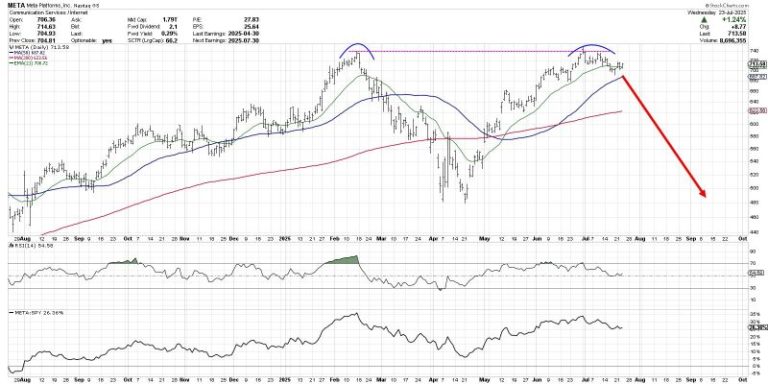
The chart of Meta Platforms, Inc. (META) has completed a roundtrip from the February high around $740 to the April low at $480 and all the way back again.  Over the last couple weeks, META has now pulled back from its retest of all-time highs, leaving investors to wonder what may come next.

Is this the beginning of a new downtrend phase for META?  Or just a brief pullback before a new uptrend phase propels META to new all-time highs?

Today we’ll look at two potential scenarios, including the double top pattern and the cup and handle pattern, and share which technical indicators and approaches could help us determine which path plays out into August.

The double top scenario basically means that the late July retest of the previous all-time high was the end of the recent uptrend phase.  The double top pattern is literally when a major resistance level is set and then retested.  The implication is that a lack of willing buyers means the uptrend is exhausted, and there is nowhere to go but down.

While the 21-day exponential moving average is currently in play for META, I would say that a break below the 50-day moving average could confirm this as the correct scenario.  If that smoothing mechanism does not hold, then the price action would imply less of a pullback and more like the beginning of a real distribution phase.

What is META pulls back but then resumes an uptrend phase, leading META to another new all-time high?  That would result in a confirmed cup and handle pattern, created by a large rounded bottoming pattern followed by a brief pullback.  The key to this pattern is the “rim” of the cup, which sits right at $740 for META.

Given the pullback META has demonstrated so far in July, I would say that a break above the $740 level would basically confirm a bullish cup and handle pattern.  That would suggest much more upside potential for META, as the stock would literally go into previously uncharted territory.

So how can we determine which scenario is more likely to play out?  This is where we need to incorporate more technical indicators into the discussion, as a way to further validate and confirm our investment thesis.

Just to review, I think a break above $740 would confirm a bullish cup and handle pattern.  I would also say that a break below the $680 level, which would represent a move below the 50-day moving average as well as the June swing lows, would basically confirm a bearish double top pattern.

We can also use the Relative Strength Index (RSI) to help determine whether META remains in a bullish trend phase.  During bull phases, the RSI rarely gets below 40, because buyers usually step in to “buy the dips” and keep the momentum fairly constructive.  So if the price would break down, and the RSI would not hold that crucial 40 level, that could mean a bearish outlook is warranted.

Finally, we can use volume-based indicators to assess whether moves in the price are supported by stronger volume readings.  Here I’ve included the Accumulation/Distribution Line, which tracks the trend in daily volume readings over time.  We can see that the high in July resulted in a divergence, as the A/D line was trending lower.  If the A/D line would break below its June and July lows, marked by a dashed red line, that would represent a bearish volume reading for META.

Technical analysis is less about predicting the future, and more about determining the most probable scenarios based on our analysis of trend, momentum, and volume.  I hope this discussion shows how the outlook for META can be easily determined and tracked using the best practices of technical analysis!

RR#6,

Dave

PS- Ready to upgrade your investment process?  Check out my free behavioral investing course!

David Keller, CMT

President and Chief Strategist

Sierra Alpha Research LLC

marketmisbehavior.com

https://www.youtube.com/c/MarketMisbehavior

Disclaimer: This blog is for educational purposes only and should not be construed as financial advice.  The ideas and strategies should never be used without first assessing your own personal and financial situation, or without consulting a financial professional.  

The author does not have a position in mentioned securities at the time of publication.    Any opinions expressed herein are solely those of the author and do not in any way represent the views or opinions of any other person or entity.

Is the market’s next surge already underway? Find out with Tom Bowley’s breakdown of where the money is flowing now and how you can get in front of it.

In this video, Tom covers key moves in the major indexes, revealing strength in transports, small caps, and home construction. He identifies industry rotation signals, which are pointing to aluminum, recreational products, and furnishings. Tom then demonstrates how to use StockCharts’ tools to scan for momentum stocks in emerging leadership groups — see why SGI tops Tom’s list. He ends with a discussion of post-earnings reactions from major names like GOOGL, TSLA, IBM, and LVS. 

And, of course, Tom wraps every idea with clear chart setups you can act on today. 

This video premiered on July 24, 2025. Click this link to watch on Tom’s dedicated page.

Missed a session? Archived videos from Tom are available at this link.

The S&P 500 ($SPX) just logged its fifth straight trading box breakout, which means that, of the five trading ranges the index has experienced since the April lows, all have been resolved to the upside.

How much longer can this last? That’s been the biggest question since the massive April 9 rally. Instead of assuming the market is due to roll over, it’s been more productive to track price action and watch for potential changes along the way. So far, drawdowns have been minimal, and breakouts keep occurring. Nothing in the price action hints at a lasting change — yet.

While some are calling this rally “historic,” we have a recent precedent. Recall that from late 2023 through early 2024, the index had a strong start and gave way to a consistent, steady trend.

From late October 2023 through March 2024, the S&P 500 logged seven consecutive trading box breakouts. That streak finally paused with a pullback from late March to early April, which, as we now know, was only a temporary hiccup. Once the bid returned, the S&P 500 went right back to carving new boxes and climbing higher.

New 52-Week Highs Finally Picking Up

If there’s been one gripe about this rally, it’s that the number of new highs within the index has lagged. As we’ve discussed before, among all the internal breadth indicators available, new highs almost always lag — that’s normal. What we really want to see is whether the number of new highs begins to exceed prior peaks as the market continues to rise, which it has, as shown by the blue line in the chart below.

As of Wednesday’s close, 100 S&P 500 stocks were either at new 52-week highs or within 3% of them. That’s a strong base. We expect this number to continue rising as the market climbs, especially if positive earnings reactions persist across sectors.

Even when we get that first day with 100+ S&P 500 stocks making new 52-week highs, though, it might not be the best time to initiate new longs.

The above chart shows that much needs to align for that many stocks to peak in unison, which has historically led to at least a short-term consolidation, if not deeper pullbacks — as highlighted in yellow. Every time is different, of course, but this is something to keep an eye on in the coming weeks.

Trend Check: GoNoGo Still “Go”

The GoNoGo Trend remains in bullish mode, with the recent countertrend signals having yet to trigger a greater pullback.

Active Bullish Patterns

We still have two live bullish upside targets of 6,555 and 6,745, which could be with us for a while going forward. For the S&P 500 to get there, it will need to form new, smaller versions of the trading boxes.

Failed Bearish Patterns

In the chart below, you can view a rising wedge pattern on the recent price action, the third since April. The prior two wedges broke down briefly and did not lead to a major downturn. The largest pullbacks in each case occurred after the S&P 500 dipped below the lower trendline of the pattern.

The deepest drawdown so far is 3.5%, which is not exactly a game-changer. Without downside follow-through, a classic bearish pattern simply can’t be formed, let alone be broken down from.

We’ll continue to monitor these formations as they develop because, at some point, that will change.

Here are some charts that reflect our areas of focus this week at


XLU Leads with New High

Even though the Utilities SPDR (XLU) cannot keep pace with the Technology SPDR (XLK) and Communication Services SPDR (XLC), it is in a leading uptrend. XLU formed a cup-with-handle from November to July and broke to new highs the last two weeks. ETFs hitting new highs are in strong uptrends and should be on our radar.


Metal Mania in 2025

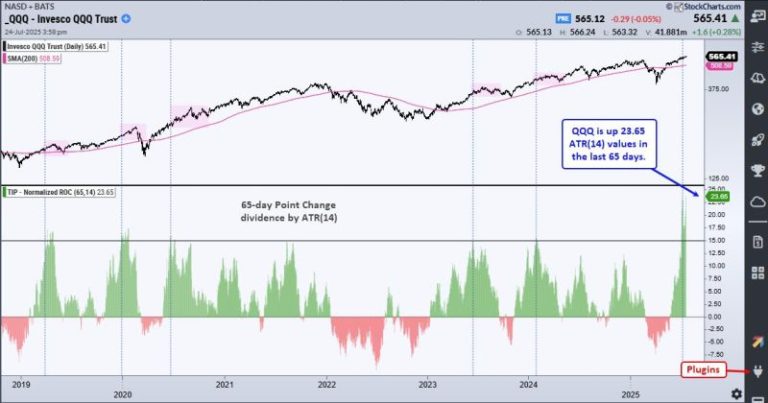
In a tribute to Ozzy, metals are leading the way higher in 2025. The PerfChart below shows year-to-date performance for the continuous futures for 12 commodities. Copper, Platinum and Palladium are up more than 45% year-to-date, while Gold is up 28.38% and Silver is up 35.30%. QQQ is up 10.52% year-to-date, but lagging these metals. The other commodities are mixed.


Multi-Year Highs for Silver and Copper

The next chart shows 11 year bar charts for five metals. Gold broke out in early 2024 and led the metals move with an advance the last 21 months. Silver and copper broke out to multi-year highs. Platinum broke above its 2021 high and Palladium got in the action with an 18 month high. There is a clear message here: metals are moving higher and leading as a group.  


Home Construction Hits Moment of Truth

The Home Construction ETF (ITB) hit its moment of truth as it rose to its falling 40-week SMA. Notice that ITB failed just below this moving average in August 2023. During the 2023-2024 uptrend, the 40-week SMA was more friendly as ITB reversed near this level in October 2023 and June 2024. ITB surged to the falling 40-week SMA in July, but the long-term trend is down and this area could be its nemesis.

Thanks for Tuning in!

See TrendInvestorPro.com for more


Don Durrett of GoldStockData.com outlines current gold and silver market dynamics, explaining why the metals continue to rise and how high they could go in the future.

He also shares his current gold and silver stock strategy.

Securities Disclosure: I, Charlotte McLeod, hold no direct investment interest in any company mentioned in this article.

This post appeared first on investingnews.com